Friday, October 14, 2016

Soberanes Fire: my time there...


Our home arroyo (by Meme)
11 Oct. 2016, 11 A.M.- just received a telephone call from Area Code 831 (Monterey County). Since I’d been there just last month I answered (yes, I pay attention to caller-ID) and found that a young lady originally from Santa Fe had been called from a number associated with my LLC @ 4 A.M. It was probably a robo-call, but it spring-boarded me into these reflections:
The phone rang about 8:30 the day after Labor Day; it was Santa Fe Zone inquiring if I was available for an assignment as a Safety Officer to the Soberanes (so-bron-es) incident in California. I soon was scurrying about to get my retiree’s “Casual Hire” approved and bags packed (I’d winterized and cached them the day before).
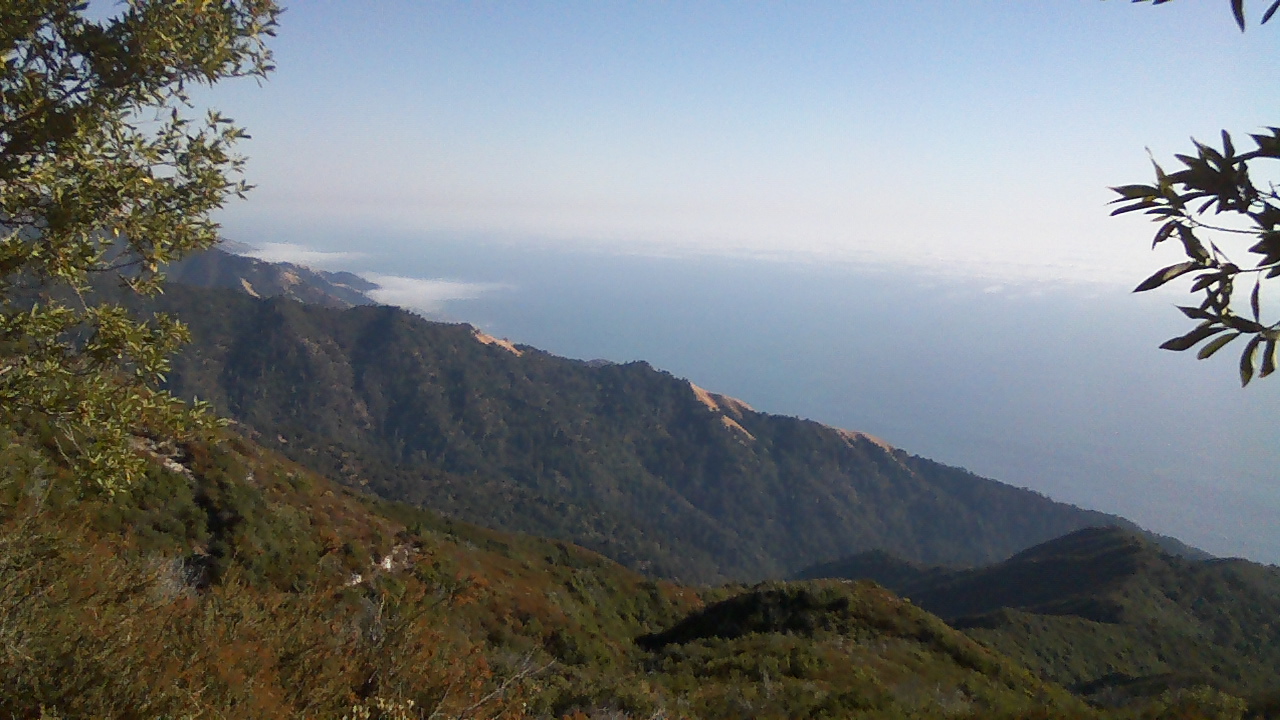
              

Coastline range
Early flights the next day: the leg into the Monterey Regional Airport I sat across the isle from organizers of a special event that would pose safety concerns & considerations for me in the coming days. More about that momentito.
Picked up at the airport by a driver from the Ground Support Unit; she stayed with me through the check-in process, until I got my own GSU ride (Ford F-150). The Soberanes fire was originally managed by a Cal Fire Type I Incident Management Team (IMT1), and had been going since late July. When I arrived an IMT1 from Alaska was managing the under Unified Command (State & Federal – Los Padres NF). I received my in-briefing from “Team Safety” and learned I was going to be the Safety Officer coordinating safety efforts at the camp established at Andrew Molera State Park near Big Sur. I’d transition with an Alaskan IMT Safety Officer that had been there for several weeks.
A near miss
The incident experienced a fatality (dozer operator from a roll-over) early on: several accidents, mishaps and near misses since were foremost in our risk analysis (due to many narrow, steep, one-way roads) and mitigations (road guards enforcing our one-way travel requirements).


This might be a spot to mention that while I was there this became the most expensive wildland fire in U.S. history (costs now over $250 million). Some may ask, why? From my perspective, there are several factors: the fire being in the vicinity of Carmel & Big Sur (Cal Fire ordered over 300 engines to protect structures); State resources in California are expensive (their contracts call for 24-hour per day pay from portal-to-portal, or from when they leave to when they return home from the incident. Also, when feasible their contract calls for hotel/motel rooms vice camping out at camps & bases. Pretty reasonable when you consider some of the 100+ degree conditions they are asked to perform their suppression efforts); managing a wilderness fire using a confinement strategy means a “Big Box” to geographically hem in the fire, lots of aircraft work ($$$) and plenty-of-patience. All this drives up costs. Has it worked? It remains at 97% contained (10/15 is estimated), with over 1,000 tactical and support personnel assigned  (at one-time I believe it was over 3,000).   
Poison Oak
What were our primary safety concerns? Aircraft usage was very high (as already noted): it is high risk – high gain + drone intrusions at a retardant dip base along Hwy 1 that could have been disastrous; driving and roads were major concerns too. On a day-to-day basis the medical unit was treating a lot of poison oak irritations and the infamous “camp crude” (upper respiratory infection) that seems to love foggy damp conditions, like where our base was located (about ½ mile off the Pacific).


The Best Buddies Ride was the special event referenced above. It featured 1700 participants riding from Carmel south on Highway 1 to Hearst Castle at San Simeon: right past our camp and major ingress/egress points on the busy Saturday following Labor Day weekend. There was a great potential for undesirable conflicts (pods of bicyclists & heavy equipment do not often mix well on narrow curve riddled roads). We were informed that the event sometimes has a medevac necessitating the closure of Hwy. 1 (our escape route), but the event would go on as planned. It did, and without incident.  Yea! https://www.bestbuddieschallenge.org/hc/

We’d had several “near miss” accidents along the narrow Coastal Ridge Road (CRR), but the following day (Sunday, 9-11) was a miss and near fatality: a water tender (WT) working along the CRR rolled off the road and over & over-n-down an 80% slope for 250-300 yards. The tender was stripped of its water tank and the driver was ejected (landing suspended on some brush), with the seat belt remaining buckled. The incident fortunately had a medevac helicopter dedicated for such emergencies (staged at Fort Hunter Liggett), and within well less than a hour the driver was airlifted out and delivered to an ER at a Regional Medical Center in Salinas. As it turns out this wouldn’t be the only time Kern County’s copter would save-our-bacon (next would be a night extraction for a medical condition: presenting like stroke). Night capable helicopters (long-line short-haul), with paramedics, are certainly the way to go amigos. BTW- the WT driver survived with many broken ribs and other painful injuries, but THANKFULLY he is OK (Humdullah!)
The Alaska IMT1 timed-out (3-weeks) while I was there, and were replaced by CA’s Interagency IMT1 Team 4 that I’d worked with last season on the River Complex. They left me “in place” and ordered replacement safety officers for our future transitioning efforts. With fire activity slowing down nationwide, those resource orders got filled sooner instead of later: I had a nice lengthy passing-of-the-baton to my replacement (a retired Forest Supervisor from the Pacific Northwest) and got to come home 2-days early to-boot. Always enjoy getting home safe-n-sound. My thoughts a good wishes to ALL that worked the Soberanes and other incidents this year: GRACIAS!


Over the years I’ve been fortunate to have worked from camps and/or bases at some fairly nice locations (and some less-than-stellar). I must say being at Big Sur was definitely a nicer locale.

Thursday, October 6, 2016

NiXfinity: or my RDK-03060 journey


I had every intention of writing about my recent fire assignment (Soberanes), and hope to do that soon. However, I thought my saga of following the Comcast/Xfinity (C/X) RDK-03060 error message trail might be worthy. Not just for a quick documentation, but it might help along some other Internet traveler.
I have been a C/X customer since 2002, and when I recently returned home from the Soberanes (at Big Sur, CA) I found that when I turned on my TV the screen had an intermittent message: “Unfortunately, this isn’t working
Make sure your HDMI cable is connected to an HDCP-capable device.
Or, if your set-top box has a component video connection, you can use a component cable to connect  to your TV…”
I had upgraded to C/X’s X1 box & bundle earlier in the year and hadn’t seen this message before. I decided to try un-hooking the X1 receiver and rebooting the entire system. That worked until the TV was turned off and restarted – the above message returned. That was day #1.

On day #2, when the “Unfortunately…” message appeared I called C/X customer service. They tried several fixes, none of which worked, then transferred me to Tier 3 X1 customer support. I worked with a technician that updated my systems firmware and tried various system tweaks – none of which worked. He felt a new HDMI cable would be the fix. While working with him, I discovered that by unplugging the HDMI cable and reinserting it in the back of the TV a picture would arrive. He suggested I change the HDMI cable and schedule a technician to bring a new X1 receiver.
On day #4, I made the 40+ mile round trip to C/X and obtained a new HDMI cable. It didn’t correct the problem.  I called Tier 3 X1 customer support (again) and got a different technician (the one I’d worked with was in training the next 2-weeks, and he’d closed out my work order as successful). We started over, unplugging and re-installing everything: it worked until turned-off and re-energized (as it had been doing). The tech was fairly certain a new X1 box would resolve the issue.
On day #8, C/X delivered a new X1 box and got it going: it worked for the day, but the next day it too had the same message and symptoms. The in-home visit tech had started with thinking it was the TV (as one of his Tier 3 colleagues had also suggested). However, after making several tests he had determined it wasn’t the TV. Since it, didn’t work I called all three technicians involved (on day #9) and left a voice-mail message to please call me. It is now day #16 and no call-backs from anyone. C/X did send me an e-mail survey and asked about my willingness to recommend C/X to friends & family: I gave them a zero (and they wondered why).

                  
While waiting for the return call, I did some on-line troubleshooting and found that tis issue is not mine alone. Several discussions and Q/A strings indicate the issue is due to a C/X update sent automatically to systems. C/X techs are telling folks to go out and buy new TV displays (mine was $3,000 – so, no thanks) and do the changes noted above. Eventually these info-strings indicate that none of the fixes tried will work = you have to ditch the HDMI cable altogether and go back to using your component cables (which C/X told me to ditch when upgrading to X1). I’ve gone back to component cables without incident. The question posed by on-line customers asking C/X: when are you going to provide a remedy for the problem you created, has gone unanswered. I find myself reflecting on the hole C/X cut in my driveway asphalt earlier this year when doing the X1 upgrade: they stated someone would be out soon to repair the hole (soon would’ve been 6-months ago), and the above. Now when I see the C/X commercial stating how much they care about customer service I laugh. I wonder how long it’ll be before I get a return call?

Thursday, August 25, 2016

"Horace Albright's reply to applicants for park ranger jobs in Yellowstone in 1926."

 U.S. Army"Buffalo Soldiers" - pre-NPS park protectors
Today is the centennial anniversary of the founding of the National Park Service (NPS). We've evolved a lot this past century. Here is a reply from Horace Albright (1st NPS Superintendent of Yellowstone, and 2nd Director of the NPS) to Park Ranger applicants to Yellowstone 90-years ago:
 
early Ranger uniform
“Qualifications of a Ranger
Applicants for a ranger’s position must be 21 years of age or must attain that age by June 15th. If you are not 21, or will not be by June 15th, don’t apply. If you have the reputation of appearing unusually youthful or immature for a man of 21, don’t apply. We want men who are mature in appearance. We prefer men of 25 to 30 years of age.

The ranger is primarily a policeman, therefore he should be big in frame, tall, and of average weight for his age and height. We always prefer big men to small men, other conditions being equal. If you are small of stature, better not apply.


Clare Marie Hodges - Yosemite, 1917
The ranger comes more closely in contact with the visiting public than any other park officer, and he is the representative of the Secretary of the Interior, the Director of the National Park Service and the Superintendent of the Park in dealing with the public. Naturally, therefore, the ranger must have a pleasing personality; he must be tactful, diplomatic, and courteous; he must be patient. If you are not possessed of such characteristics, please don’t apply. Without them you would become, if selected, a failure from the beginning of your service.


Ranger talk
The ranger is charged with the protection of the natural features of the Park, especially the forests. Applicants should present evidence of their having had experience in camping out in the woods. Forestry students who have had training in forestry work and forest fire fighting are given preference to other applicants if they possess the qualifications as to age, size, and personality.

Me at Tonto Nat'l Mon.
The ranger must know how to cook ordinary foods and must have experience in kitchen police. If you cannot cook and care for a ranger station, don’t apply. You would be an unpopular burden on your fellow rangers and the butt of all station jokes should you be selected without this essential qualification.

We want big mature men with fine personalities and experience in the out-of-doors in riding, camping, woodcraft, fighting fires, and similar activities.

Duties of A Ranger
The ranger force is the park police force, and is on duty night and day in the protection of the park. Protection work primarily relates to the care of the forests, the fish and game, the geyser and hot spring formations and the campgrounds. Of equal importance is the detection of violations of the speed rules. The ranger force is the information-supplying organization. The issuance of publications, answering of questions, lecturing, and guiding are all accomplished by rangers.”


Per George Robinson, Chief of NPS Education & Visitor Services (Retired).
Then


Now

Monday, August 22, 2016

“Don’t Bury Me On The Lone Prairie; I’d Rather Play There Live…” Cosmic Cowboy


19 AUG 2016: As I sit at the Old Santa Fe Trail building’s information desk, doing a volunteer-in-parks (VIP) gig, I’m reflecting on the 100-years that the National Park Service (NPS) has been attempting to protect park areas via their legislated mandate "to conserve the scenery and the natural and historic objects and the wild life therein and to provide for the enjoyment of the same in such manner and by such means as will leave them unimpaired for the enjoyment of future generations." Considering present expectations of a high-octane special-effects world, that’s often tough to achieve, for so many lessons from NPS areas are subtle in nature. Many take years, decades or even generations to appreciate and understand.

Emily Erickson
It has been many new moons since I’ve posted anything, even though I’ve thought about various semi-worthy topics: old resource protection cases, archeological observations, or other non-polarizing topics  (abortion, same-sex marriage, climate change, income guarantees, gun control, etc. - NOT). So, I’ll just compose a few updates of some trips here in the southwestern part of the U.S.A. (its been fairly mundane- no dive trips or exotic destinations):

In May, I flew over to central Arizona: our goddaughter, Emily Erickson, graduated from the Gilbert Classic Academy (high school) and soon starts in the nursing program at Grand Canyon University (under scholarship: way-to-go Emily!). She and her younger brother Andrew were also preparing for a trip to London, which they did in June I believe (I bet that was blog worthy). 


I spent much of June in Arizona at two wildfires as a Safety Officer. The initial dispatch was to the Juniper Fire on the Payson/Pleasant Valley Ranger District of the Tonto National Forest (NF). The Incident Command Post was in Young, AZ, and as some of you might remember Meme & I used to own some acres in Young that we bought while working in Tonto Basin (myself at Tonto National Monument & Meme w/ the Forest Service). It was an interesting assignment, seeing the changes and/or places that looked pretty much like they had in 1978 (or probably 1938). The fire grew to about 30,000 acres and achieved many of what are termed “management objectives.” In other words… it did good. Plus there were no major incidents or injuries: well maybe one. There was a “Lesson Learned” by a UTV operator (a Division Supervisor) re: the value of wearing a DOT approved helmet. He was wearing one (instead of a fire helmet) when his ride flipped. May have saved his life or great bodily harm. We went through several transitions there, as the Incident Management Team (IMT) went from a 3 to a 2 back to a 3 during my tenure. Transitions are always a heads-up/watch-out time (more than usual), too many tragedies occur during them.

My second “roll” in June was to the Cedar Fire on the White Mountain/Fort Apache Agency. The fire was threatening the towns of Show Low, Lakeside-Pinetop and the casino at Hondah. So, this was a Type I (IMT) fire with many complex issues that come with a wildland-urban interface incident. I was assigned to work with the two structural protection groups (north & south), which made for some long days. It still feels gratifying that I can contribute in some small way, realizing that any fire could be my last. I used to be a young firefighter/Park Ranger, now I’m usually “the old guy” (but that in itself can be a walking safety message). I got to “tie-in” with Mark Harvey, a retired NPS Park Ranger that lives close to us in Eldorado: he was playing “Mr. Demob” for the incident. While there we experienced some minor issues, but while we were headed home (another transition period) there was a crew that had multiple fire shelter deployments.


July found me waiting for another assignment: I’ve been asked on numerous occasions “why aren’t you in California?” Good question, and I can only re-state there seems little rhyme-or-reason to when the phone rings from “Santa Fe Zone” (our local interagency dispatcher). So instead, I had to decide between attending my yoga class at SFCC, or trying to qualify for the Olympic Fantasy Team in “butterfly walking” followed by a pint of porter for a cool-down period. I selected both-of-the-above. I also enjoyed a day on the upper Pecos River with a fly fishing guide. Our catch-n-release adventure landed about 2-dozen rainbow & brown trout, with the largest being ca. 20” and 3-lbs. No pictures, as I was busy… The month had much hotter temps than normal, but brought on the cooling monsoonal moisture in time for our “just about annual” trip to Pacific Beach. As usual, dispatch called me 2-days before the system showed me as “not available” for a fire assignment (previous years it has been the day before we left for the coast). Tough choice, but the Pacific was calling (besides, we had Meme’s retirement from the Office of the State Engineer. Her last day in the office was the end of July, with August being an annual leave month). Besides we wanted to catch up with Meme’s brother Mark & stepbrother Charlie (still flying for Alaska Airlines), which we were able to do while enjoying the warm sand & surf.

We knew at the end of last year that the Dept. of Interior’s International Technical Assistance Program involving our work & efforts in Petra were being shut down. It became final recently when I was asked to sign a closeout contract document. I’ll miss our many friends and adventures there, and of course working with retired NPS Rangers Bill Wade & Bruce McKeeman. My biggest surprise of the summer was at our locale market (The Agora): at the frozen foods I ran into Nancy Wizner. We’d worked together at Santa Monica Mountains and she resides in western Colorado. We are going to stay-in-touch.


The second week of August we finally got up to Red River, NM (aka “Little Texas”) for a concert by Michael Martin Murphey (MMM). The town is ca. 8600’ and we stayed in a nice historic room above Texas Reds steakhouse (same Texas Red as of “Big Iron” fame). The chuck wagon dinner & concert was held in an amphitheater at an old ranch a couple miles from town (at about 10,000’ – glad we had our hoodies). It was a very casual scene with MMM talking to some of us pre-concert. Meme made a couple of requests, one of which (“Southwestern Pilgrimage”) he started off the show singing, after leading in with the backstory of how it’d been requested by a Lady from Santa Fe and he’d written it years ago when leaving Austin and its music scene in his rearview mirror for the wide open spaces and Rocky Mountains. Later in the concert, he made some conservation comments: noting that the reason they didn’t have a campfire blazing was the amount of pines around the lake & hillside that had suffered bug-kill. There were some stringers you could see during daylight. Anyway, he mentioned the Beaver Creek fire in northern Colorado (Routt NF), close to his ranch, and even though it was wet, the diseased trees were burning – over 35,000 acres. "Cosmic Cowboy" went down well all around.

Last night a bunch of Meme’s rock climbing amigos y amigas held a really nice potluck at Wolf’s hacienda off upper Canyon Road, using her retirement from the State of NM as an excuse. I think some road trips are in the works. Anyway, that is about it for now, take care and “be careful out there”…